ROS 2 in a Nutshell: A Survey

Abdulrahman Al-Batati1, Anis Koubaa2, Mohamed Abdelkader1, Khaled Gabr1, Hamad Aloqaily1
1Robotics and IoT Lab, Prince Sultan University    2College of CIS, Alfaisal University
ACM Computing Surveys (Under Review)
8,033
Papers Surveyed
960
ROS 2 Publications
176
Community Packages
2009–2025
Years Covered

Abstract

The Robot Operating System (ROS) has been the de facto standard framework for developing robotics applications since 2009. Its successor, ROS 2, addresses critical limitations in reliability, real-time performance, security, and multi-robot scalability through a fundamentally redesigned architecture built on the Data Distribution Service (DDS) middleware.

This survey provides a comprehensive, multidimensional review of ROS 2 research, guided by three research questions:

RQ1: How does ROS 2 improve upon ROS 1 in architecture, design goals, and features, and what new limitations arise?
RQ2: What advances in ROS 2's technical foundations emerge from the literature, and how are they deployed?
RQ3: What frameworks, libraries, and tools have emerged in the ROS 2 ecosystem, and which areas remain underdeveloped?

We analyze over 8,200 publications spanning 2009–2025, organizing advances into four pillars: (1) middleware architectures, (2) real-time scheduling and hardware acceleration, (3) security, privacy, and safety, and (4) multi-robot and distributed coordination. The survey is accompanied by a curated, publicly accessible database of ROS-related resources.
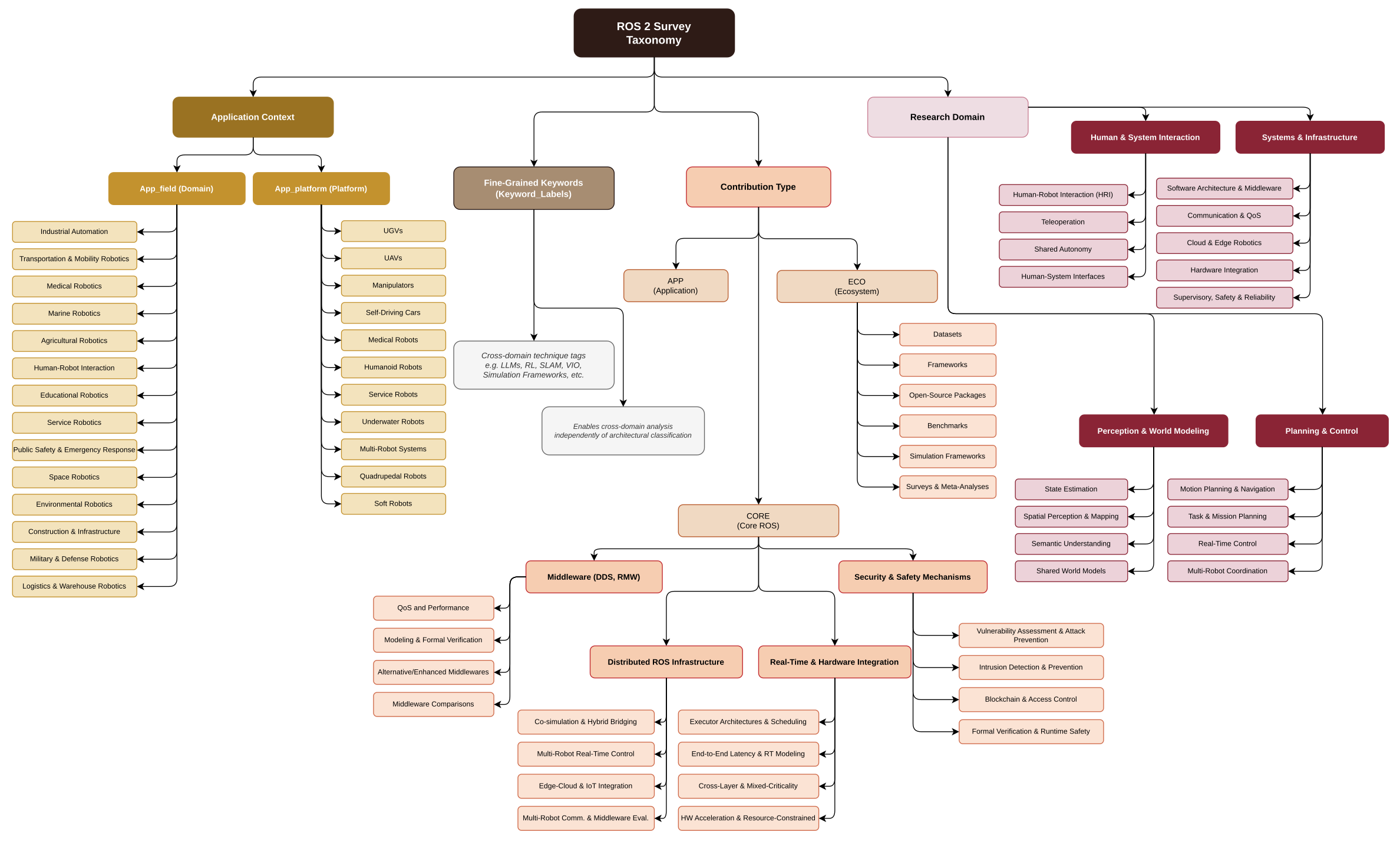
Four Research Pillars

1 Middleware Architectures

DDS-based communication, RMW abstraction layers, QoS policies, Zenoh as a post-DDS alternative, and the "readiness paradox" of operational complexity vs. architectural sophistication.

2 Real-Time & Hardware Acceleration

Executor models, PREEMPT_RT integration, response-time analysis, micro-ROS for MCUs, FPGA/GPU acceleration, and cross-layer scheduling frameworks.

3 Security, Privacy & Safety

SROS2 overhead benchmarks, DDS Security, intrusion detection, privacy-aware data flow, mixed-criticality scheduling, and formal verification.

4 Multi-Robot & Distributed Systems

Fleet management (Open-RMF), DDS discovery in large networks, edge/cloud offloading, heterogeneous coordination, and scalability challenges.

Database Insights

Quantitative analysis from our curated database of 8,033 ROS publications.

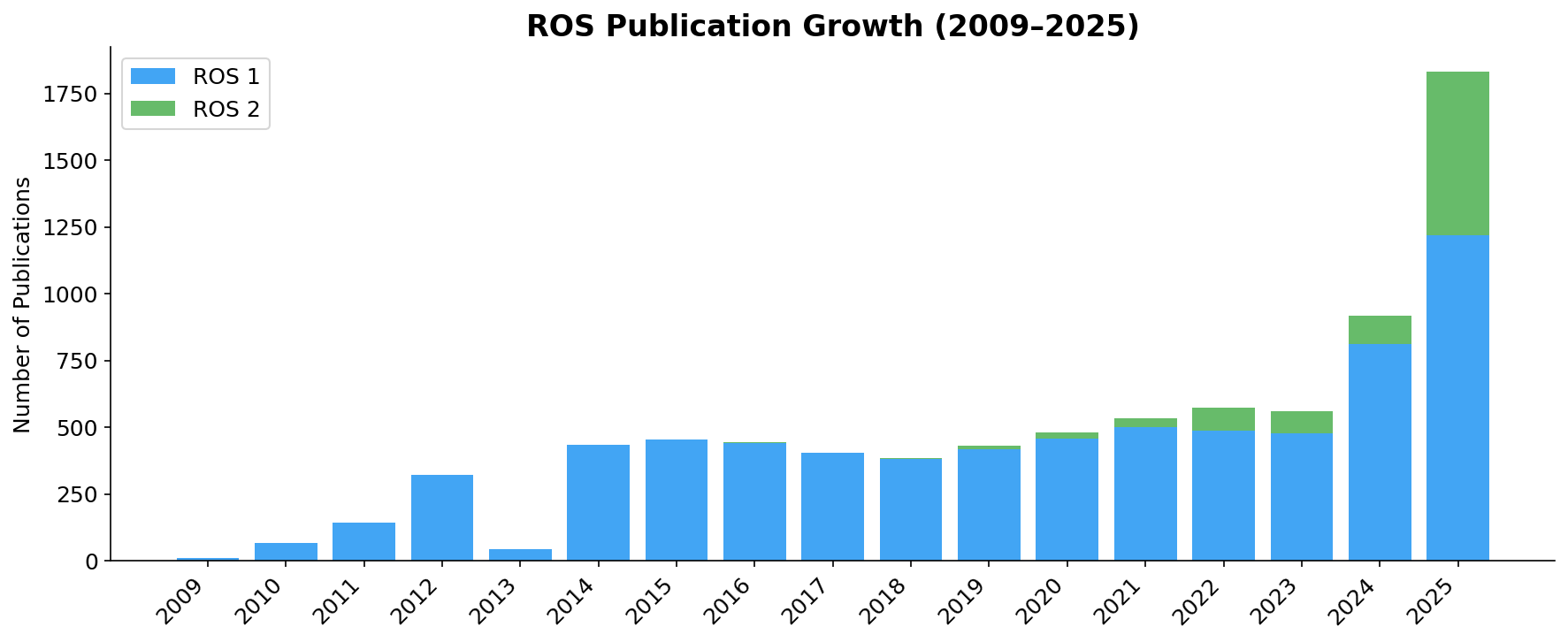
Publication Growth

Publication growth: ROS 1 vs ROS 2 (2009–2025). ROS 2 research has grown steadily since 2017.

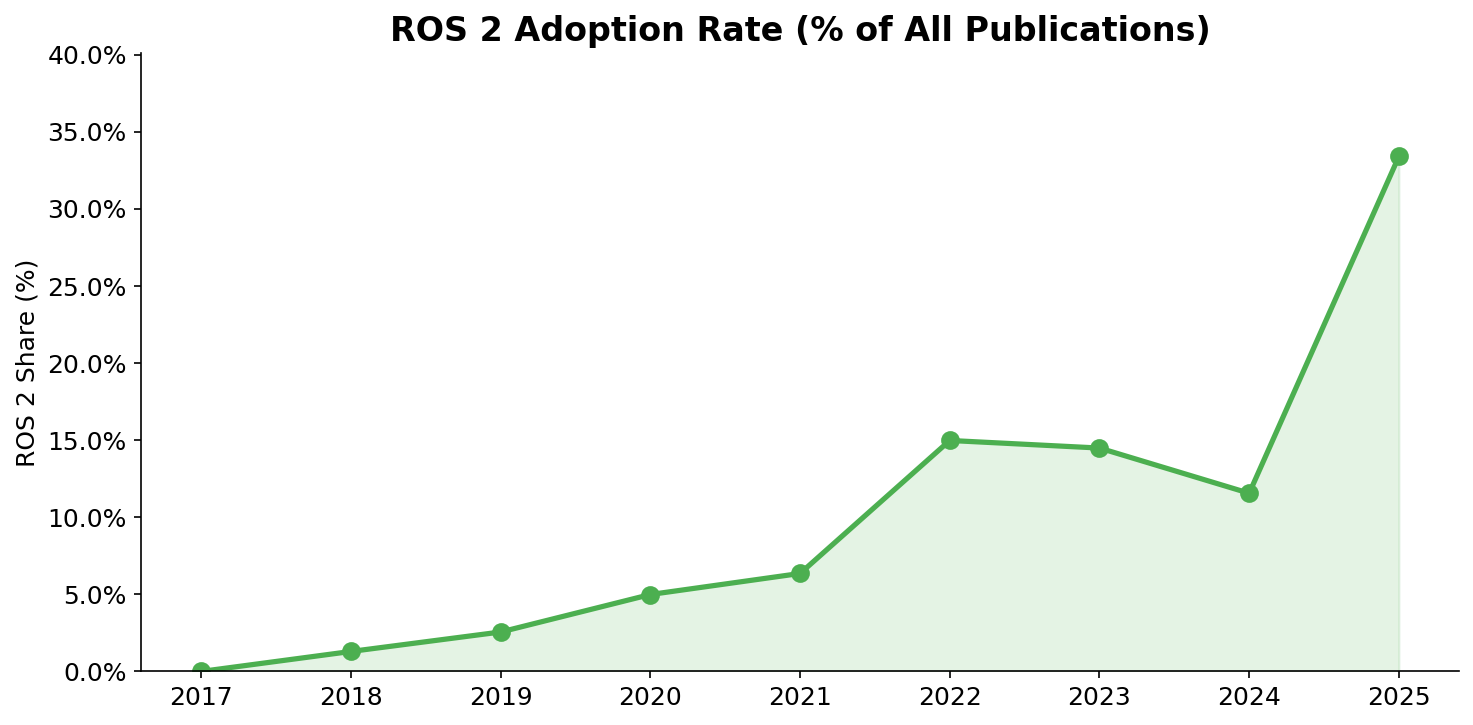
ROS 2 Adoption

ROS 2's share of all ROS publications over time.

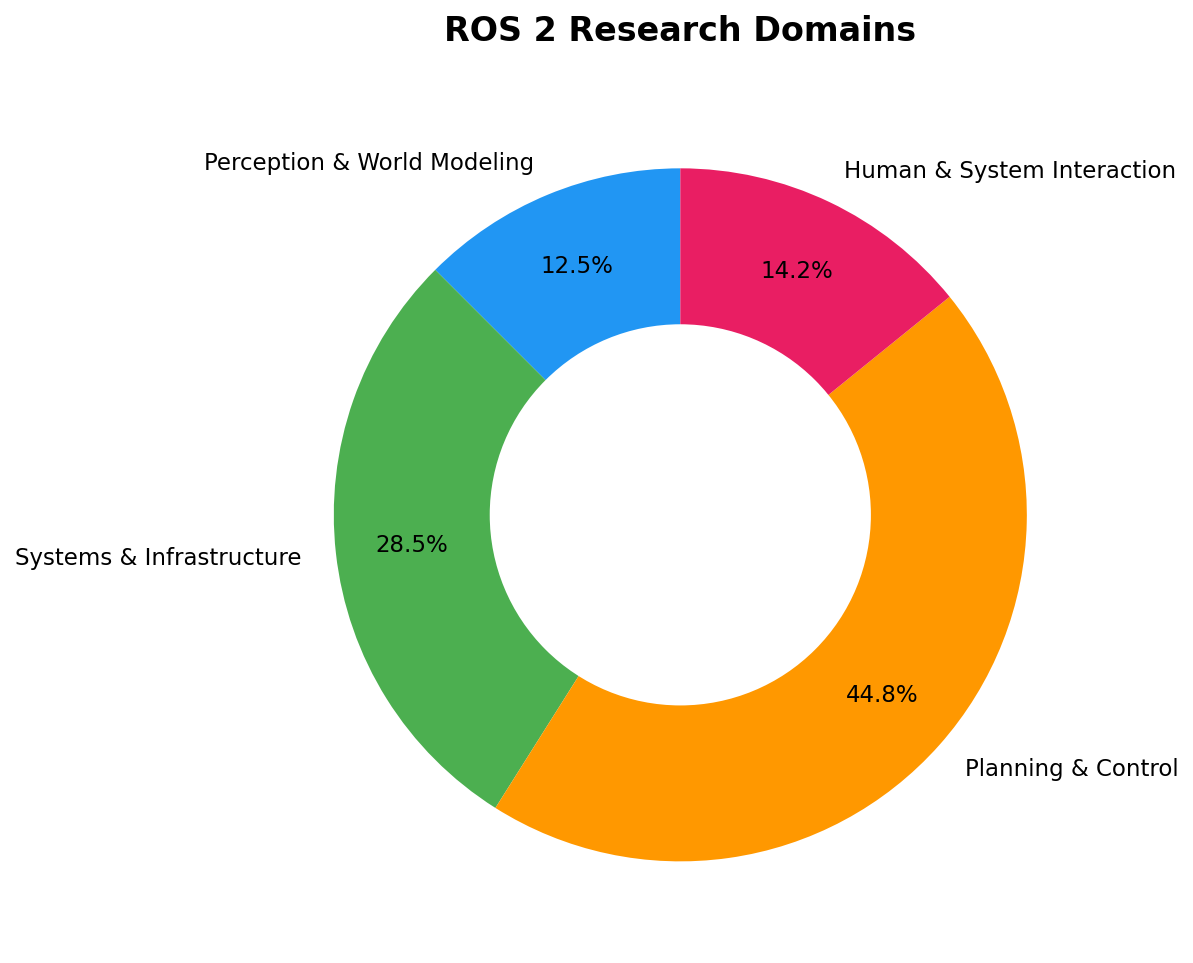
ROS 2 Research Domains

Distribution of ROS 2 research across application domains.

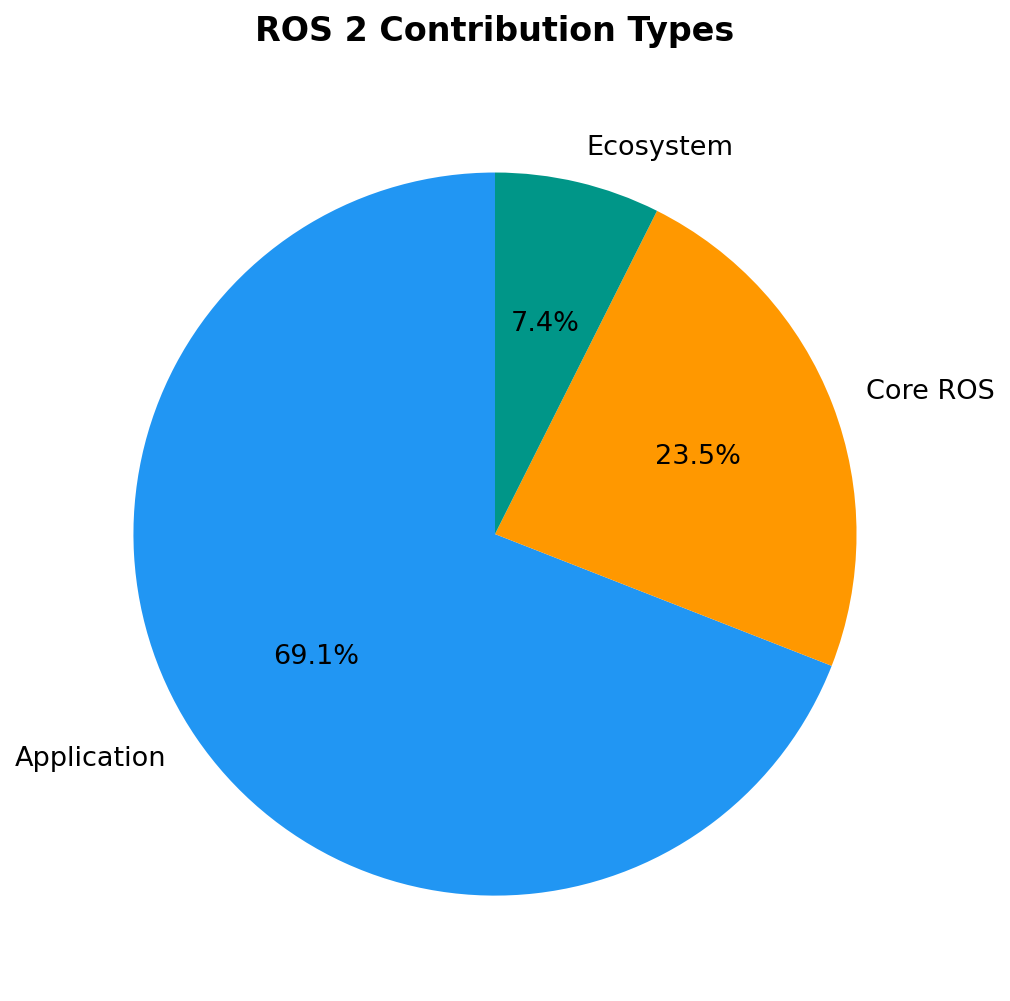
Article Types

ROS 2 article type distribution: Applications, Core, and Ecosystem.

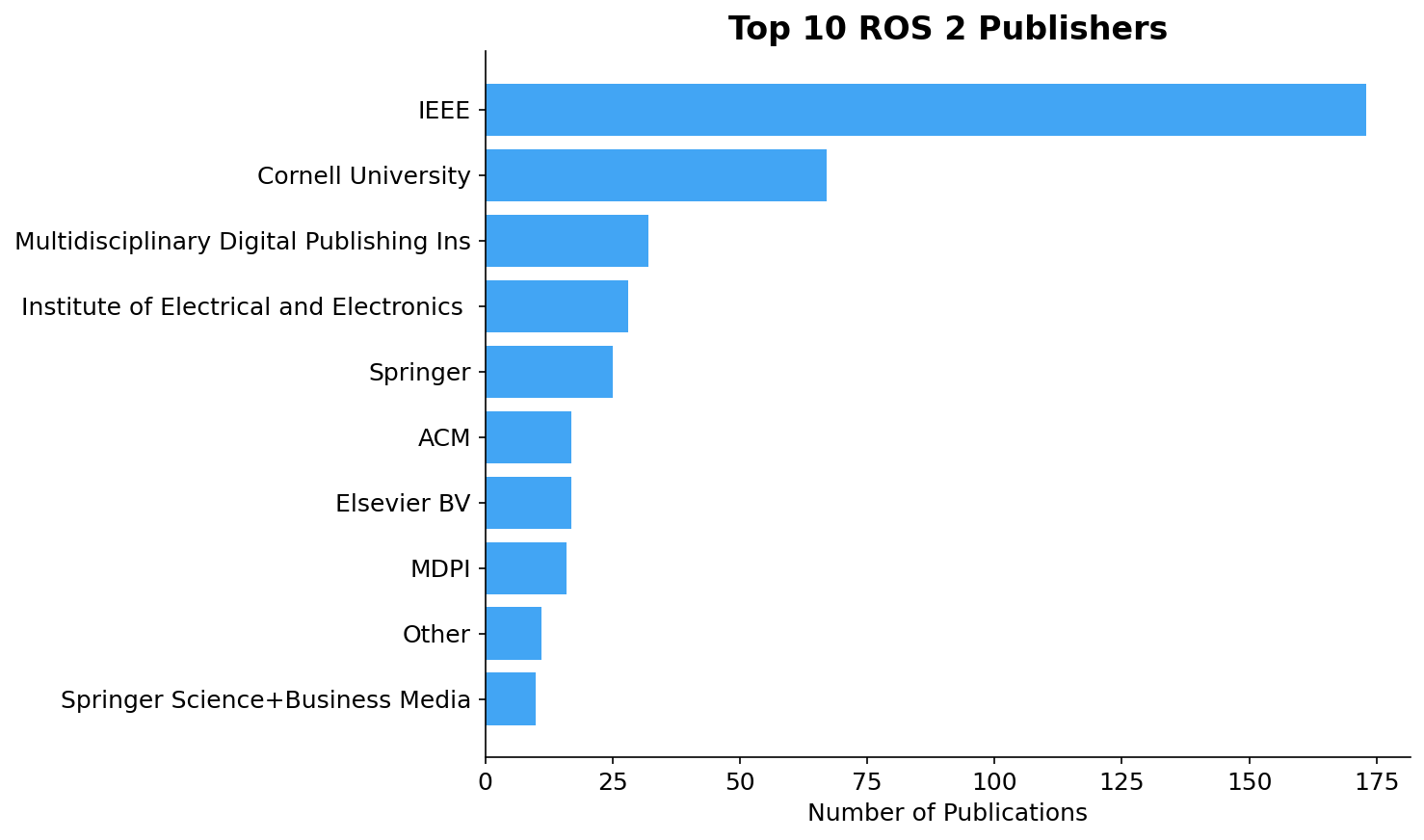
Top Publishers

Top publishers of ROS 2 research.

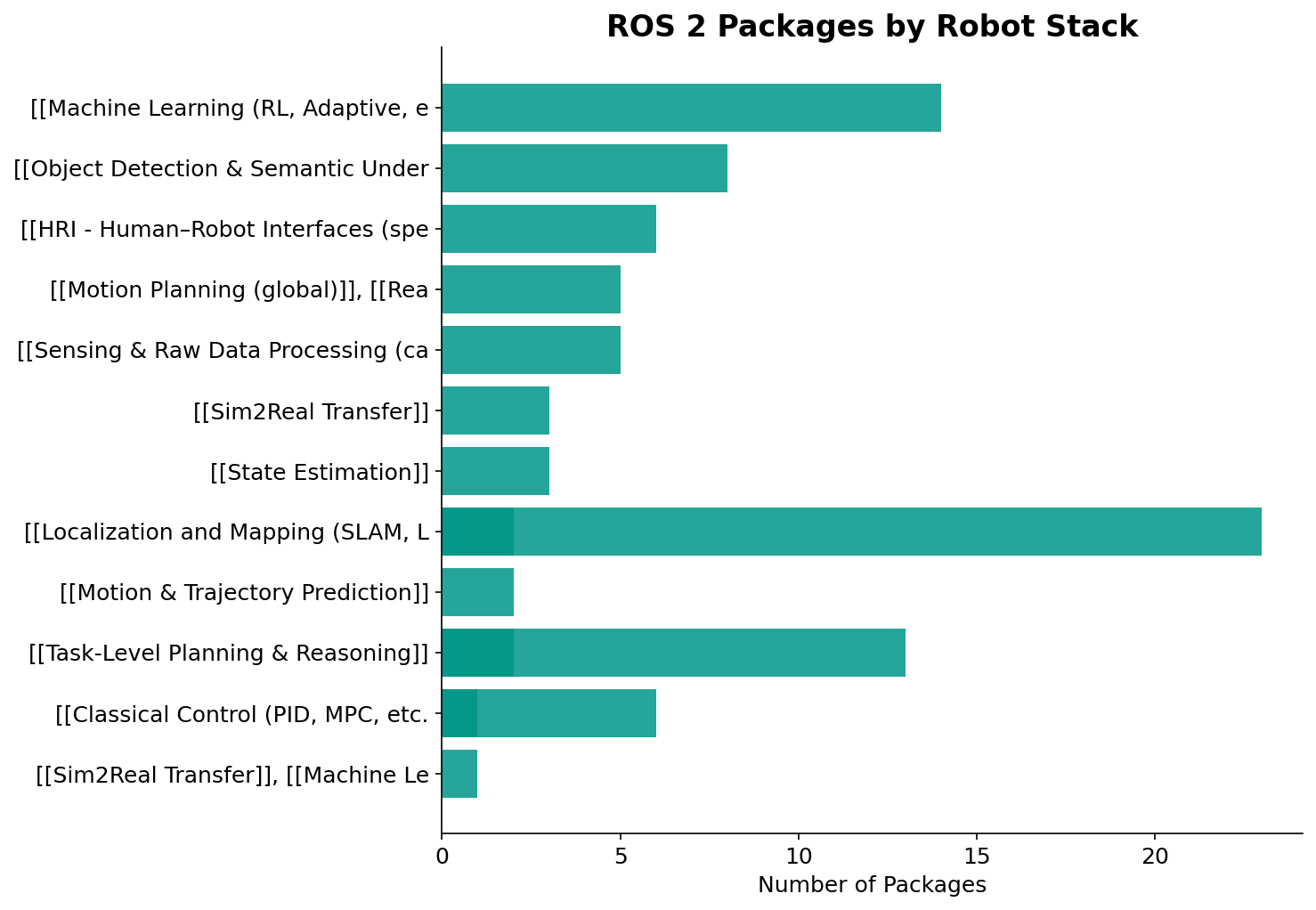
Package Categories

ROS 2 community packages categorized by robot stack and infrastructure type.

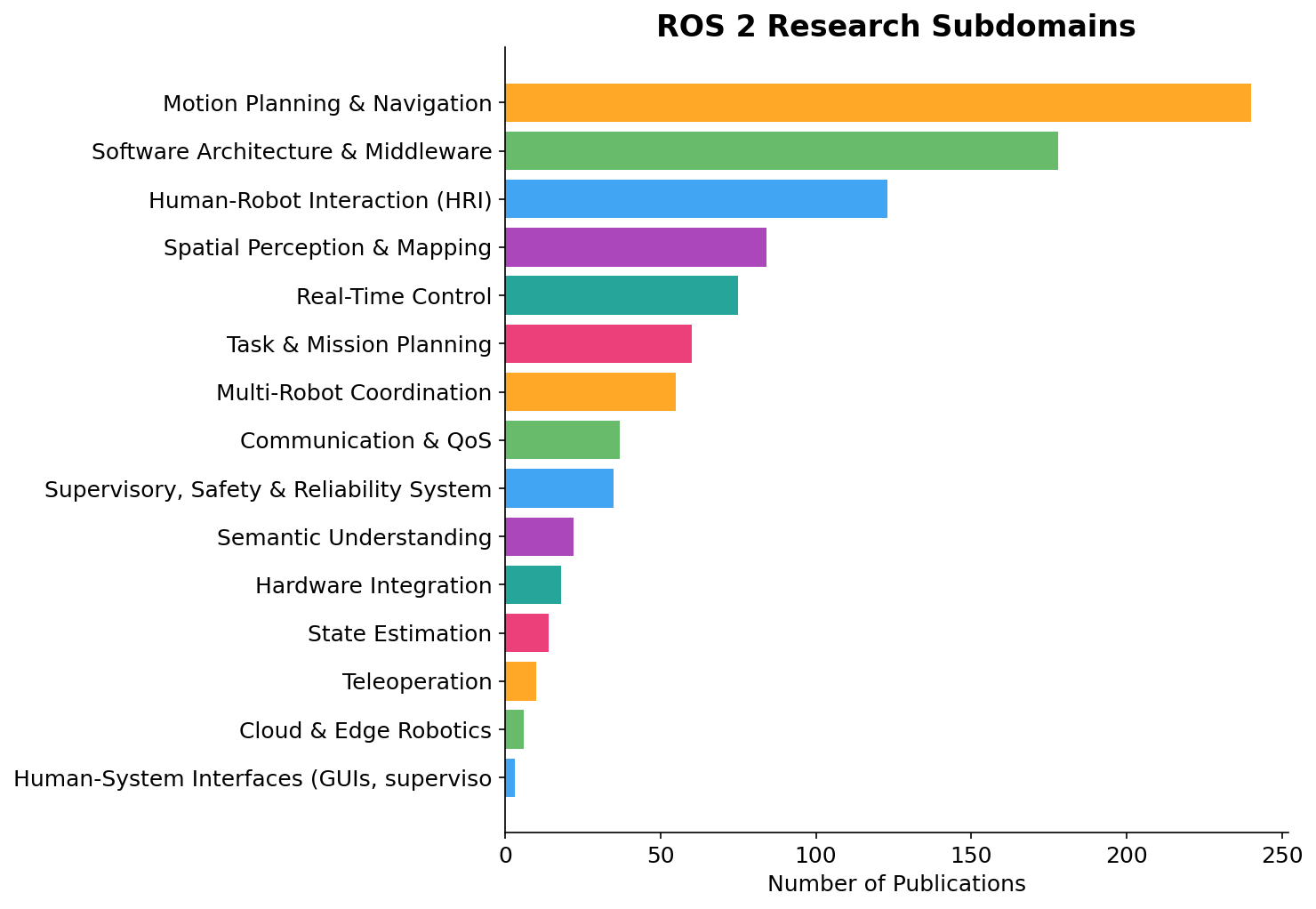
Research Subdomains

ROS 2 research subdomain distribution across the taxonomy.

Key Findings

  • ROS 2 adoption is accelerating: ROS 2 distributions collectively account for nearly half of all ROS downloads since 2023, with 960 ROS 2-focused publications indexed in our database of 8,033 papers.
  • Real-time remains an open frontier: While executors, QoS policies, and PREEMPT_RT integration improve predictability, end-to-end determinism depends on OS configuration, DDS vendor, and executor design. SROS2 adds 0.5–2 ms per hop.
  • The readiness paradox: ROS 2's architecture surpasses ROS 1, but DDS discovery storms, vendor-specific QoS semantics, and multicast tuning difficulties mean deployment complexity persists. Zenoh (Tier-1 RMW since Jazzy) reduces discovery overhead by 97–99%.
  • Safety-critical domains are underrepresented: Navigation/SLAM (~28%) and manipulation (~18%) dominate, while surgical robotics and aerospace account for <5% combined.
  • Ecosystem growth: 176 curated community packages span perception, planning, control, simulation, and fleet management.
  • Community-maintained dataset: The full dataset is publicly available on GitHub under CC-BY-4.0, welcoming community contributions.

BibTeX

@article{albatati2025ros2survey,
  author    = {Al-Batati, Abdulrahman and Koubaa, Anis and Abdelkader, Mohamed and Gabr, Khaled and Aloqaily, Hamad},
  title     = {ROS 2 in a Nutshell: A Survey},
  journal   = {Pending},
  year      = {2026},
}